
 Other Languages
What Is the Washington Fair Chance Act?
English - (PDF / 318kb)
በሥራ ቅጥር ውስጥ የወንጀል መዝገብ መረጃን መጠቀም - Amharic
Verwendung von Informationen aus dem Strafregister bei der Personaleinstellung - German
रान आपराधिक रिकॉर्ड की जानकारी का इस्तेमाल - Hindi
ច្បាប់ស្តីពីឱកាសស្មើភាពគ្នានៅរដ្ឋវ៉ាស៊ីនតោន - Khmer
Kõjerbale melele ko ikijen criminal record ñan kabbok rijerbal - Marshallese
ਨੌਕਰੀ ਦੀ ਨਿਯੁਕਤੀ ਵਿੱਚ ਅਪਰਾਧਿਕ ਰਿਕਾਰਡ ਦੀ ਜਾਣਕਾਰੀ ਦੀ ਵਰਤੋਂ - Punjabi
Использование информации о криминальном прошлом при приеме на работу - Russian
Faaaogaina o Faamaumauga o Solitulafono i le Faafaigaluegaina - Samoan
Uso de información sobre antecedentes penales en la contratación de empleo - Spanish
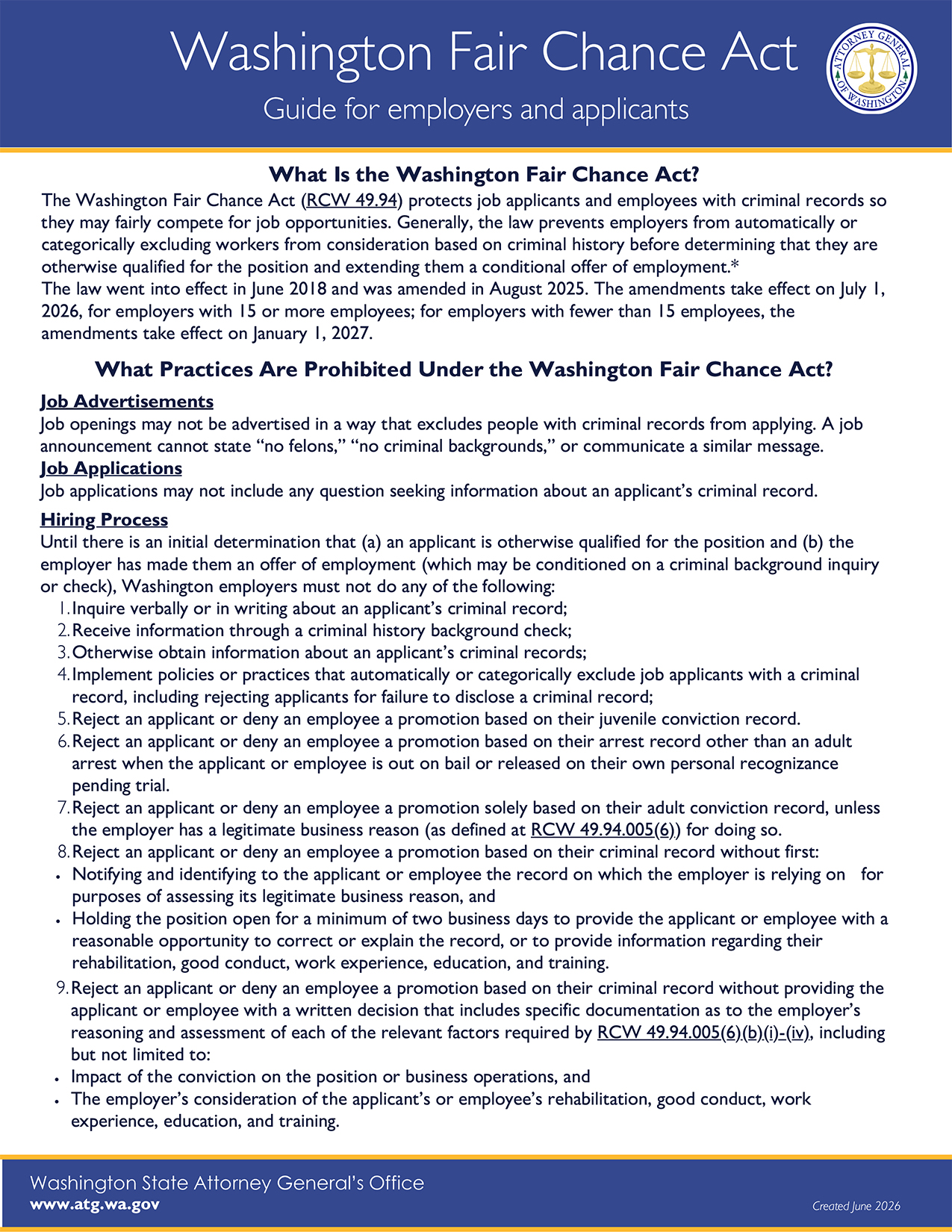
The Washington Fair Chance Act (RCW 49.94) protects job applicants and employees with criminal records so they may fairly compete for job opportunities. Generally, the law prevents employers from automatically or categorically excluding workers from consideration based on criminal history before determining that they are otherwise qualified for the position and extending them a conditional offer of employment.*
The law went into effect in June 2018 and was amended in August 2025. The amendments take effect on July 1, 2026, for employers with 15 or more employees; for employers with fewer than 15 employees, the amendments take effect on January 1, 2027.
What Practices Are Prohibited Under the Washington Fair Chance Act?
Job Advertisements
Job openings may not be advertised in a way that excludes people with criminal records from applying. A job announcement cannot state “no felons,” “no criminal backgrounds,” or communicate a similar message.
Job Applications
Job applications may not include any question seeking information about an applicant’s criminal record.
Hiring Processes
Until there is an initial determination that (a) an applicant is otherwise qualified for the position and (b) the employer has made them an offer of employment (which may be conditioned on a criminal background inquiry or check), Washington employers must not do any of the following:
- Inquire verbally or in writing about an applicant’s criminal record;
- Receive information through a criminal history background check;
- Otherwise obtain information about an applicant’s criminal records;
- Implement policies or practices that automatically or categorically exclude job applicants with a criminal record, including rejecting applicants for failure to disclose a criminal record;
- Reject an applicant or deny an employee a promotion based on their juvenile conviction record.
- Reject an applicant or deny an employee a promotion based on their arrest record other than an adult arrest when the applicant or employee is out on bail or released on their own personal recognizance pending trial.
- Reject an applicant or deny an employee a promotion solely based on their adult conviction record, unless the employer has a legitimate business reason (as defined at RCW 49.94.005(6)) for doing so.
- Reject an applicant or deny an employee a promotion based on their criminal record without first:
- Notifying and identifying to the applicant or employee the record on which the employer is relying on for purposes of assessing its legitimate business reason, and
- Holding the position open for a minimum of two business days to provide the applicant or employee with a reasonable opportunity to correct or explain the record, or to provide information regarding their rehabilitation, good conduct, work experience, education, and training.
- Reject an applicant or deny an employee a promotion based on their criminal record without providing the applicant or employee with a written decision that includes specific documentation as to the employer’s reasoning and assessment of each of the relevant factors required by RCW 49.94.005(6)(b)(i)-(iv), including but not limited to:
- Impact of the conviction on the position or business operations, and
- The employer’s consideration of the applicant’s or employee’s rehabilitation, good conduct, work experience, education, and training.
- Terminate, suspend, discipline, demote, or deny a promotion to an employee because the employee, or a person acting on behalf of the employee, makes a good faith report, orally or in writing, to the employer, the attorney general, a labor organization, or others of a violation or suspected violation of the Washington Fair Chance Act or otherwise informs others of the requirements of the law.
What Is a Criminal Record?
Definitions for terms used in the Washington Fair Chance Act are provided at RCW 49.94.005.
"Criminal record" includes any record of or information about a citation or arrest for criminal conduct, including records relating to probable cause to arrest, and includes any record about an adult criminal or juvenile case filed with any court, whether or not the case resulted in a finding of guilt.
What If a Job Applicant Voluntarily Discloses Their Criminal Record During an Interview?
If an applicant voluntarily discloses information about their criminal record during an interview, without the employer asking, the employer must immediately:
- Provide the applicant with this Washington Fair Chance Act Guide for Employers and Job Applicants; and
- Inform the applicant in writing that:
- An employer may not ask for or receive information about an applicant’s criminal history until after making an initial determination that (a) the applicant is otherwise qualified for the position and (b) making a conditional offer of employment;
- An employer may not implement policies or practices that automatically or categorically exclude job applicants with a criminal record, including rejecting applicants for failure to disclose a criminal record prior to receiving a conditional offer of employment;
- An employer may not carry out a tangible adverse employment action based on an applicant’s or employee’s adult arrest record or juvenile conviction record, provided the individual is not out on bail or released on their own personal recognizance pending trial; and
- An employer may not carry out a tangible adverse employment action solely based on an applicant’s or employee’s adult conviction record, unless the employer has a legitimate business reason for taking such action.
How Do I Report A Violation of The Washington Fair Chance Act?
Anyone may file a complaint under the Washington Fair Chance Act, not only job applicants. You can file a complaint about a potential violation of the Washington Fair Chance Act with the Attorney General’s Office by emailing us at fairchancejobs@atg.wa.gov, calling (833) 660-4877, or using our online form. A staff member will follow up with you.
______________________________________________________________________________
* The Washington Fair Chance Act does not apply to roles for which the applicant or employee will or may have unsupervised access to children under 18, vulnerable adults, or vulnerable persons, as defined by law; law enforcement or criminal justice agencies; national or registered securities entities; non-employee volunteer positions; positions for which employers are permitted or required by law to ask about and consider information about an applicant’s criminal record for employment purposes; or positions entailing work under a federal contract that prohibits persons with criminal history from working under that contract.